

Seiko Presage Classic Craftsmanship: Handcrafted Enamel & Urushi Lacquer Dials

Seiko Presage Classic Series Expands with Handcrafted Enamel and Urushi Lacquer Dials
The Seiko Presage Classic Series has become a showcase for traditional Japanese decorative arts, and the latest additions push that legacy even further. Two new Craftsmanship models — the HCC005 with an enamel dial and the HCC006 with urushi lacquer — honor the 1913 Laurel, Japan's first wristwatch, while demonstrating that centuries-old artisanal techniques remain vibrantly alive in modern watchmaking.
Two Ancient Crafts, One Design Language
According to Monochrome Watches, both watches share the same case architecture and layout but express themselves through radically different decorative techniques. Their 30m water-resistant cases measure 39.6mm in diameter and 12.4mm thick. The enamel model (HCC005) is finished in stainless steel with a super-hard coating, while the urushi version (HCC006) features a warm yellow gold-colored plating on its steel case. Both use dual-curved sapphire crystals with anti-reflective coating and screw-down exhibition casebacks.
The Enamel Dial: HCC005
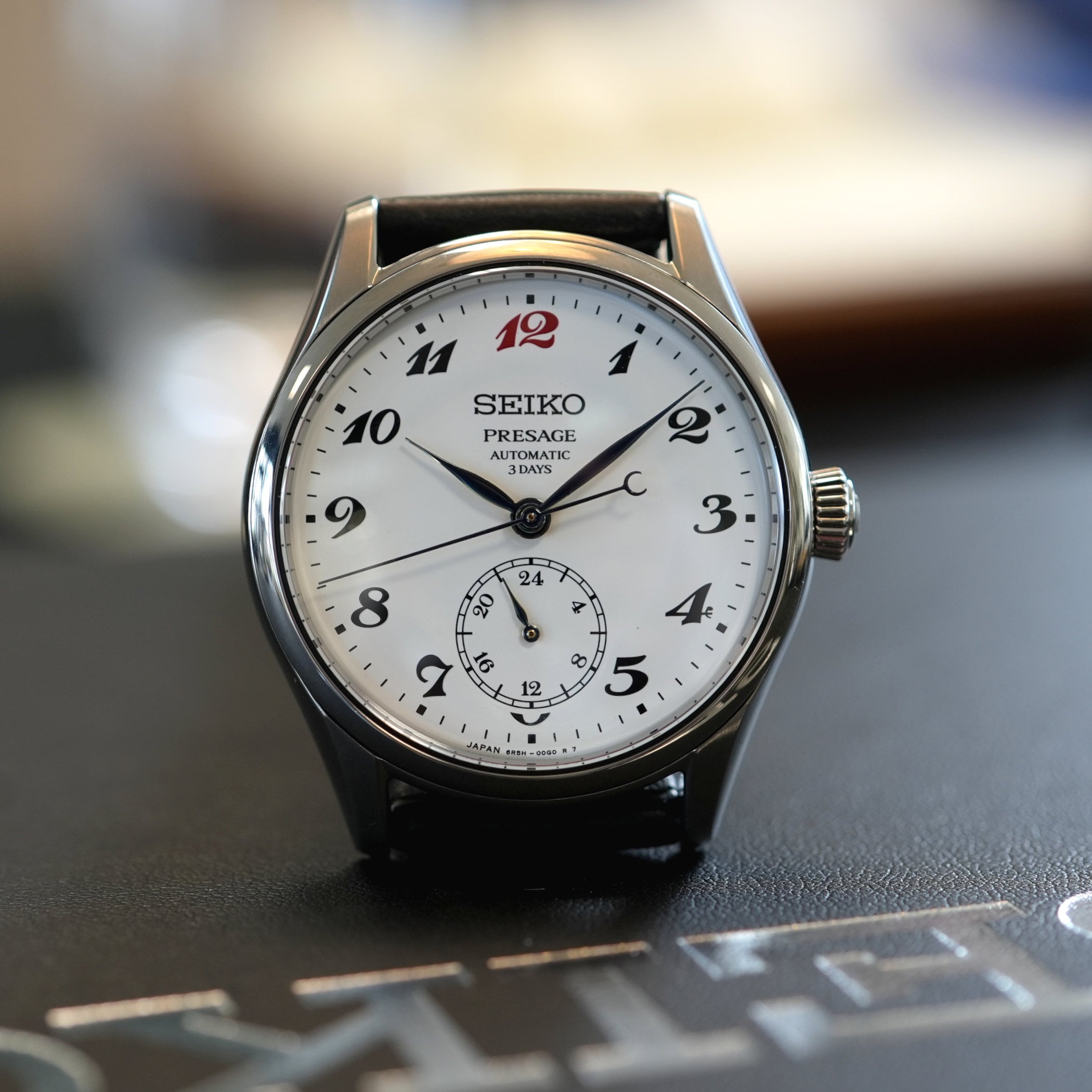
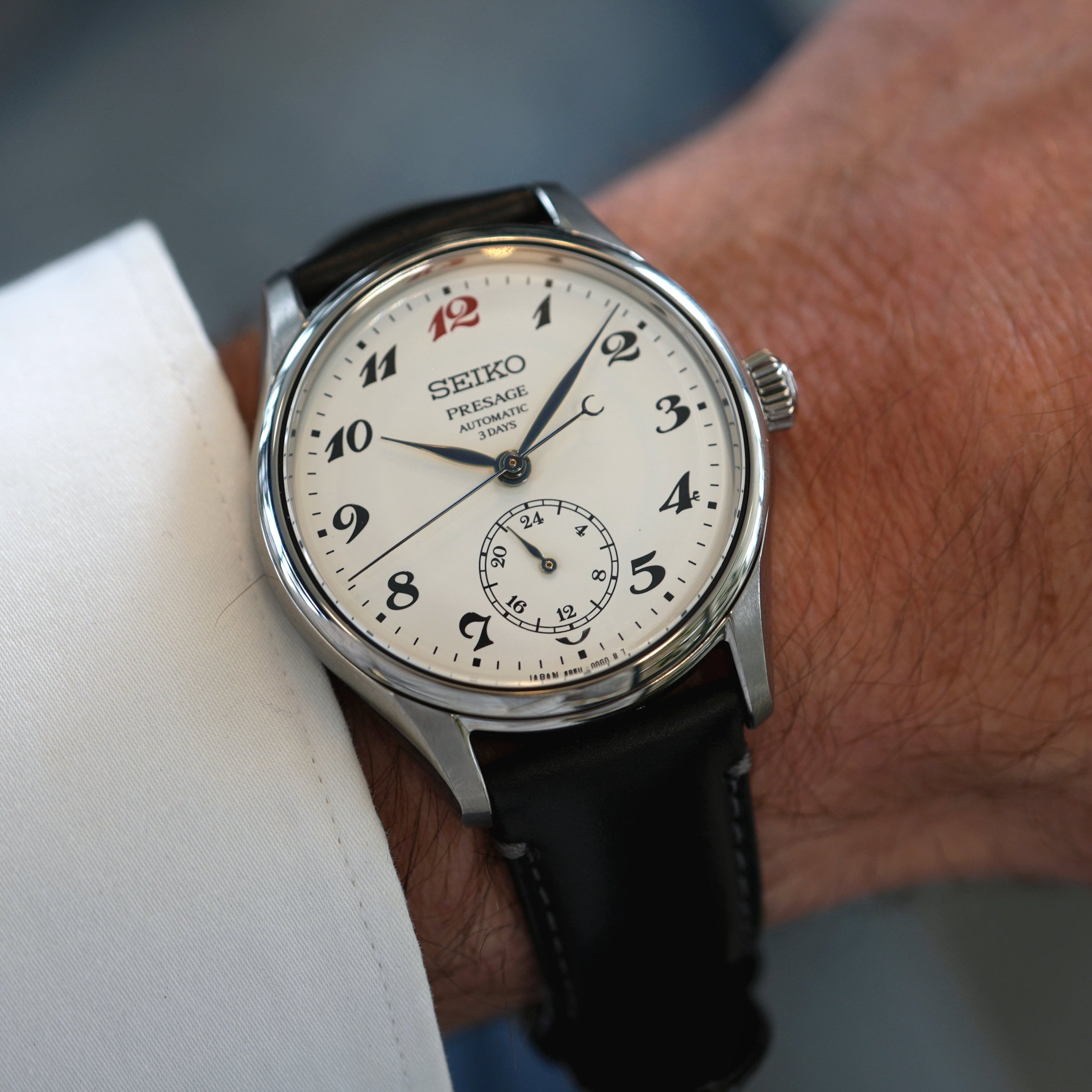
The HCC005 revisits the Laurel's distinctive appearance with a glossy white enamel dial crafted using traditional techniques. Finely ground enamel is applied to a copper base and fired repeatedly at temperatures approaching 800°C, creating a surface prized for its remarkable depth, permanence, and resistance to fading.
Production is overseen by master enamel artisan Mitsuru Yokosawa, assisted by Kazunori Uchiyama, whose apprenticeship under Yokosawa ensures the continuity of this increasingly rare craft. The dial faithfully echoes the Laurel through elegant Arabic numerals, including the characteristic red "12" — a signature feature of Seiko's historic wristwatch. Blue handset and a 24-hour subdial at 6 o'clock complete the classical presentation.
The Urushi Lacquer Dial: HCC006
The HCC006 interprets the same historical design through the equally demanding art of urushi lacquer. This technique develops an unmistakable richness and lustre through successive layers of hand-applied lacquer and repeated polishing. Produced under the supervision of renowned lacquer master Isshu Tamura, with execution by Toshikazu Tsuji, Mitsuki Tsuji and their workshop, the dial combines deep black lacquer with gold-colored numerals, indices, and hands.
Technical Specifications
| Feature | HCC005 (Enamel) | HCC006 (Urushi Lacquer) |
|---|---|---|
| Diameter | 39.6mm | 39.6mm |
| Thickness | 12.4mm | 12.4mm |
| Case Material | Steel, super-hard coated | Steel, gold-colored plating |
| Dial | White enamel | Black urushi lacquer |
| Hands | Blue | Gold-colored |
| Movement | Calibre 6R5H Automatic | Calibre 6R5H Automatic |
| Jewels | 24 | 24 |
| Power Reserve | 72 Hours | 72 Hours |
| Frequency | 21,600 vph | 21,600 vph |
| Accuracy | -15/+25 sec/day | -15/+25 sec/day |
| Water Resistance | 30m | 30m |
| Strap | Oil-tanned leather (LWG-certified) | Oil-tanned leather (LWG-certified) |
| Availability | September 2026 | September 2026 |
| Price | EUR 1,430 | EUR 1,640 |
The Laurel Connection
Both watches draw their design DNA from the 1913 Laurel — Seiko's first wristwatch and a milestone in Japanese horological history. The Arabic numeral typography, the red "12" on the enamel version, and the overall dial layout are faithful reinterpretations of this historic model. The 24-hour subdial at 6 o'clock is a modern addition that provides additional functionality while maintaining the classical aesthetic.
These are continuous production models, not limited editions, making them accessible to collectors who appreciate traditional craftsmanship without the pressure of limited availability. Both models use Seiko's modern calibre 6R5H, which delivers a 72-hour power reserve at 21,600 vibrations per hour.
Artisanal Craftsmanship at Scale
What makes these watches remarkable is the juxtaposition of centuries-old handcraft with modern manufacturing. Each enamel dial requires repeated firing at extreme temperatures, supervised by a master artisan. Each urushi lacquer dial demands successive layers of hand-applied lacquer and meticulous polishing. Yet these are priced at EUR 1,430 and EUR 1,640 — levels that make genuine artisanal watchmaking accessible to a far broader audience than most European haute horlogerie brands.
FAQ
Q: What is the difference between enamel and urushi lacquer dials?
A: Enamel involves firing finely ground glass powder at high temperatures (around 800°C) to create a permanent, glossy surface. Urushi lacquer is a natural material harvested from the sap of lacquer trees, applied in multiple layers and polished to achieve depth and lustre. Both are extremely labor-intensive and require years of artisanal training.
Q: Are these limited editions?
A: No, both the HCC005 and HCC006 are joining the permanent Presage Classic Series collection. They will be available continuously through Seiko Boutiques and selected retailers from September 2026 onward.
Q: Why is the urushi model more expensive?
A: The EUR 210 price difference reflects the additional cost of the gold-colored plating on the case and the complexity of urushi lacquer production. Urushi requires specialized artisans, environmental conditions (high humidity for curing), and more time-intensive production than enamel.
Related Reading
- Complete Guide to Seiko Presage Collection
- Japanese Watchmaking Traditions: Enamel, Urushi, and Arita Porcelain
Source: According to Monochrome Watches, published August 13, 2026.