

ISO 6425 Dive Watch Standard: How Modern Innovations Are Reshaping Certification

ISO 6425 Dive Watch Standard: How Modern Innovations Are Reshaping Certification
From Oil-Filled Cases to Spring Drive: The Evolution of Dive Watch Technology
The ISO 6425 standard has served as the benchmark for dive watch certification since its introduction, establishing rigorous testing protocols that ensure watches can perform reliably in demanding underwater environments. In 2024-2026, a wave of innovative dive watches has demonstrated how modern technology is pushing the boundaries of what this standard can encompass—from oil-filled cases to ultra-precise spring drive movements.
As documented by Monochrome Watches in their comprehensive analysis of oil-filled watches, the intersection of ISO 6425 compliance and cutting-edge technology is producing some of the most fascinating dive watches in the market today.
Understanding ISO 6425: The Complete Testing Protocol
ISO 6425, formally titled "Horology — Dive watches," defines the minimum requirements for watches intended for diving. Unlike simple water resistance ratings, ISO 6425 certification involves a comprehensive battery of tests:
| Test | Requirement |
|---|---|
| Water Resistance | Test at 125% of rated depth pressure |
| Thermal Shock | Alternating immersion in 40°C and 5°C water |
| Condensation | No condensation on crystal after temperature changes |
| Overpressure | 10% above rated pressure for 2 hours |
| Bezel Function | Unidirectional rotation with minute markings |
| Luminous Legibility | Readability at 25cm in darkness conditions |
| Timing Device | Ability to measure elapsed time up to 60 minutes |
| Magnetic Resistance | Indication of magnetic resistance on dial |
| Shock Resistance | Survival of impacts from 1m height onto hardwood |
Innovation 1: Oil-Filled Technology Meets ISO 6425
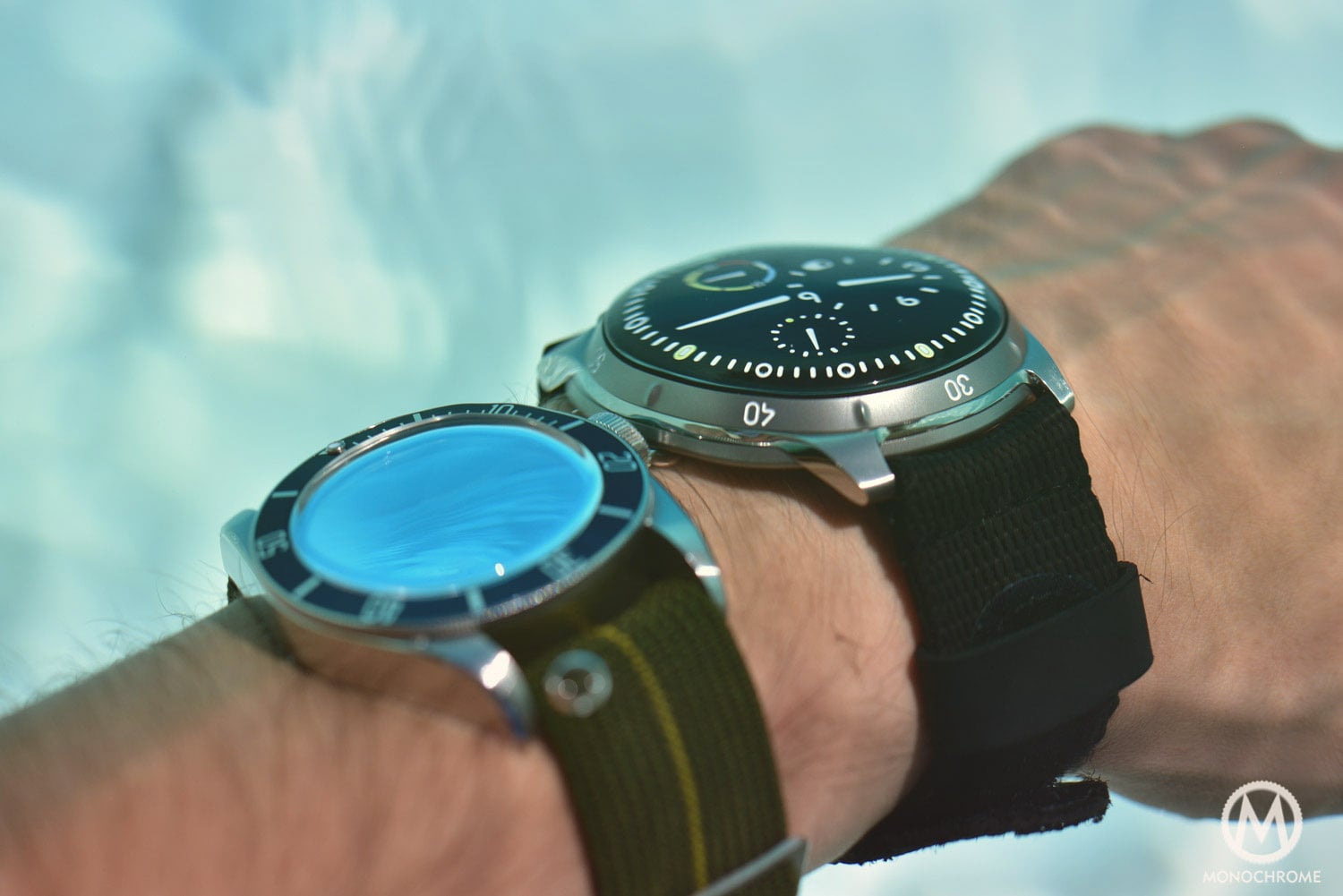
Perhaps the most radical approach to ISO 6425 compliance comes from oil-filled dive watches. According to Monochrome Watches, brands like Ressence, Sinn, and Bell & Ross have developed oil-filling technologies that not only meet ISO 6425 standards but offer unique advantages underwater.
The Ressence Type 5, for example, fills its dial-side module with silicon-based oil that shares the same refractive index as sapphire crystal. This eliminates the air-crystal interface that causes reflections, creating a dial that appears to float within the crystal with zero distortion—a particular advantage in murky underwater conditions where conventional dive watches may be difficult to read.
Sinn's HYDRO technology takes oil-filling further, using it to achieve water resistance ratings up to 5,000 meters. As Monochrome Watches notes, "Cases are actually rated for 11,000 metres, which is deeper than the deepest part of the ocean at the Mariana Trench, but the quartz movements themselves are only rated for 5,000 metres of pressure."
Innovation 2: Ultra-Precision Spring Drive Movements

Grand Seiko's Spring Drive UFA (Ultra Fine Accuracy) technology represents another leap forward for ISO 6425-certified dive watches. The brand's new Ushio 300 Diver achieves an annual accuracy of ±20 seconds—approximately ±3 seconds per month—making it the most accurate mainspring-powered dive watch ever produced.
This level of precision, while not directly required by ISO 6425, enhances the practical utility of dive watches for timing decompression stops and bottom times. When every second counts in a diving scenario, having a timepiece that maintains exceptional accuracy provides an additional margin of safety.
Innovation 3: Design Refinements for Better Compliance
The ISO 6425 standard has also influenced design decisions in less obvious ways. As revealed by Seiko's recent SPB451 and SPB453 Prospex models, the standard's requirement for luminous hour markers can drive significant design changes. By relocating the date window to 4:30, Seiko was able to restore a full luminous marker at 3 o'clock, improving ISO 6425 compliance while maintaining the date function that many buyers expect.
Similarly, Grand Seiko's decision to eliminate the date display on the Ushio 300 Diver ensures all hour markers remain luminous—a direct response to ISO 6425 requirements that has the added benefit of creating a cleaner, more balanced dial design.
Comparing ISO 6425-Certified Innovations
| Watch | Innovation | Water Resistance | Price Range |
|---|---|---|---|
| Ressence Type 5 | Oil-filled dial, zero reflections | 100m | $35,000+ |
| Sinn HYDRO | Oil-filled case, 5000m rating | 5,000m | $3,000-5,000 |
| Grand Seiko Ushio 300 | ±20 sec/year Spring Drive UFA | 300m | EUR 12,500 |
| Glashütte Original SeaQ Chrono | Flyback chronograph, DIN 8306 | 300m | $14,700 |
| Seiko SPB453 | Redesigned for ISO compliance | 300m | $1,300 |
The Future of ISO 6425
As dive watch technology continues to evolve, the ISO 6425 standard may need to adapt to accommodate new innovations. Current challenges include:
- Satellite-connected dive computers: Smart dive computers increasingly integrate GPS and connectivity features that traditional dive watches lack
- Advanced materials: New materials like carbon composites and ceramic alloys offer different performance characteristics
- Hybrid movements: Watches combining mechanical and electronic elements may require new testing protocols
- Environmental sustainability: Growing demand for eco-friendly materials and manufacturing processes
FAQ
Q: Can a watch be called a "dive watch" without ISO 6425 certification?
A: Technically, any watch with water resistance can be used for diving, but ISO 6425 certification is the only internationally recognized standard that verifies a watch has been tested for the specific demands of diving. Without certification, manufacturers cannot legally use the term "dive watch" in official marketing in many jurisdictions.
Q: How often should an ISO 6425-certified watch be tested?
A: Most manufacturers recommend pressure testing every 2-3 years for watches used regularly for diving. Even if a watch passes initial ISO 6425 certification, seals and gaskets degrade over time and should be inspected regularly to maintain water resistance.
Q: Are oil-filled dive watches practical for everyday use?
A: Oil-filled watches like the Ressence Type 5 offer excellent legibility in all conditions, not just underwater. However, they require specialized servicing and have limitations on movement options (typically quartz or hybrid). For most users, conventional mechanical dive watches offer a better balance of practicality and performance.
According to Monochrome Watches, the ISO 6425 standard continues to evolve as new technologies emerge, with brands like Ressence, Sinn, and Grand Seiko pushing the boundaries of what a certified dive watch can achieve.
Learn more about dive watch standards in our complete guide to dive watch certifications.