
Hublot's SAXEM Revolution: When Aerospace Technology Meets Luxury Watchmaking
Hublot Pushes Material Science Boundaries with Revolutionary SAXEM Technology
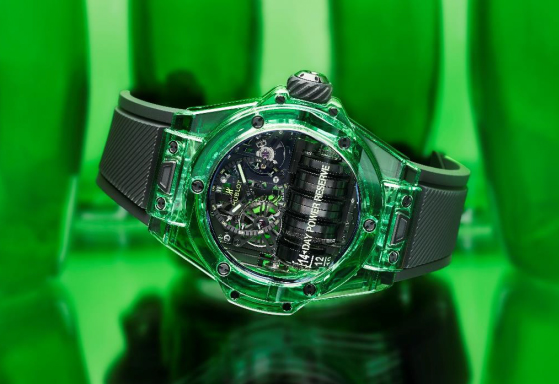
In the ever-evolving landscape of luxury watchmaking, Hublot continues to establish itself as the undisputed leader in material innovation. The Swiss manufacturer's latest achievement — the introduction of SAXEM (Sapphire Aluminium oXide) technology in the Big Bang MP-11 — represents a quantum leap in how watch cases can be engineered, combining aerospace-grade materials with haute horlogerie craftsmanship.
What is SAXEM? Understanding the Science Behind the Innovation
SAXEM is a revolutionary material that combines aluminium oxide — the fundamental component of sapphire — with rare-earth elements including thulium, holmium, and chromium. This precise chemical composition produces a material with extraordinary optical properties:
| Property | Traditional Sapphire | SAXEM |
|---|---|---|
| Crystal Structure | Hexagonal | Cubic |
| Color Consistency | Varies by angle | Uniform from all angles |
| Internal Tension | Present | Absent |
| Transparency | High | Exceptional |
| Hardness (Mohs) | 9 | 9 |
| Primary Application | Jewelry, optics | Satellite technology, watchmaking |
The Big Bang MP-11: A Technical Masterpiece
The Big Bang MP-11 in green SAXEM showcases Hublot's technical prowess through several key innovations:
- 7-Barrel Power Reserve: The manual-winding manufacture caliber delivers an extraordinary 14-day power reserve, visible through the transparent SAXEM case
- "Endless Screw" Crown: A distinctive fluted crown design allows for efficient manual winding of the seven barrels
- Limited Production: Only 20 pieces worldwide, emphasizing the exclusivity of this material innovation
- Green SAXEM Case: A striking emerald-green hue that rivals the finest precious stones
Richard Guadalupe on Hublot's Innovation Philosophy
Hublot CEO Richard Guadalupe explained the significance of this material breakthrough: "With this new Big Bang MP-11, Hublot once more asserts its regal mastery of innovation, at both a technical level and in terms of aesthetics. By offering those that seek accomplishment a state-of-the-art material used in very high-tech applications, particularly in satellites, and by combining it with a manufacture movement with levels of performance that will go down in history, we are changing the face of our Art of Fusion."
SAXEM vs. Traditional Case Materials
The watchmaking industry has long relied on a limited palette of case materials. Hublot's SAXEM technology expands the possibilities:
- Stainless Steel: Durable but common; offers limited aesthetic differentiation
- Titanium: Lightweight and strong; popular in sport watches
- Ceramic: Scratch-resistant; limited to opaque colors
- Sapphire Crystal: Transparent; difficult to machine, prone to internal stress
- SAXEM: Combines transparency, color vibrancy, cubic crystal structure (uniform appearance), and aerospace-grade durability
Hublot's Legacy of Material Innovation
The SAXEM Big Bang MP-11 follows a lineage of material breakthroughs from Hublot:
- Magic Gold (2012): The world's only scratchproof gold, combining 18k gold with boron carbide ceramic
- King Gold: A proprietary alloy with a warmer hue than traditional rose gold
- 3D Carbon: A multi-layered carbon composite with striking visual patterns
- Transparent Sapphire: Full sapphire cases in previous MP-11 iterations
- SAXEM (2019): The next evolution in transparent case materials
Impact on the Luxury Watch Market
Hublot's material innovations have profound implications for the luxury watch industry:
- Patent Protection: Proprietary materials create competitive moats that are difficult for competitors to replicate
- Collectibility: Limited-edition material innovations often appreciate in value on the secondary market
- Brand Identity: Material science has become a core differentiator in the luxury segment
- Cross-Industry Applications: Technologies developed for watches find applications in aerospace, medical devices, and other high-tech sectors
FAQ: Hublot SAXEM Technology
Q: Is SAXEM the same as synthetic sapphire?
A: No. While both are based on aluminium oxide, SAXEM incorporates rare-earth elements that create a cubic crystal structure, resulting in different optical and physical properties compared to traditional hexagonal sapphire.
Q: How scratch-resistant is SAXEM?
A: SAXEM achieves a hardness of 9 on the Mohs scale, comparable to sapphire and ruby, making it virtually scratchproof under normal wearing conditions.
Q: Can SAXEM be produced in different colors?
A: In theory, yes. By varying the rare-earth elements and their concentrations, different colors could be achieved. Currently, Hublot has showcased green SAXEM, but future iterations may explore other hues.
Q: Why is the Big Bang MP-11 limited to 20 pieces?
A: The combination of limited SAXEM production capacity and the complexity of manufacturing a 7-barrel movement in a SAXEM case restricts production. This exclusivity also enhances collectibility.
The Future of Material Innovation in Watchmaking
As Hublot continues to pioneer new materials, the watch industry is watching closely. The implications extend beyond aesthetics:
- Sustainability: Advanced materials may offer more environmentally friendly production methods
- Performance: New materials can enhance water resistance, shock protection, and magnetic resistance
- Customization: Advanced manufacturing techniques like DRIE enable unprecedented design freedom
For collectors and enthusiasts, Hublot's SAXEM innovation represents more than a new watch — it's a glimpse into the future of what's possible when cutting-edge material science meets traditional watchmaking artistry.
Sources
- WatchPro: Hublot releases Big Bang MP-11 in material never before used in watchmaking
- aBlogtoWatch: Hublot Innovation Coverage
- WorldTempus: Material Science in Watchmaking
Learn more about watch materials | Explore our luxury watch guide